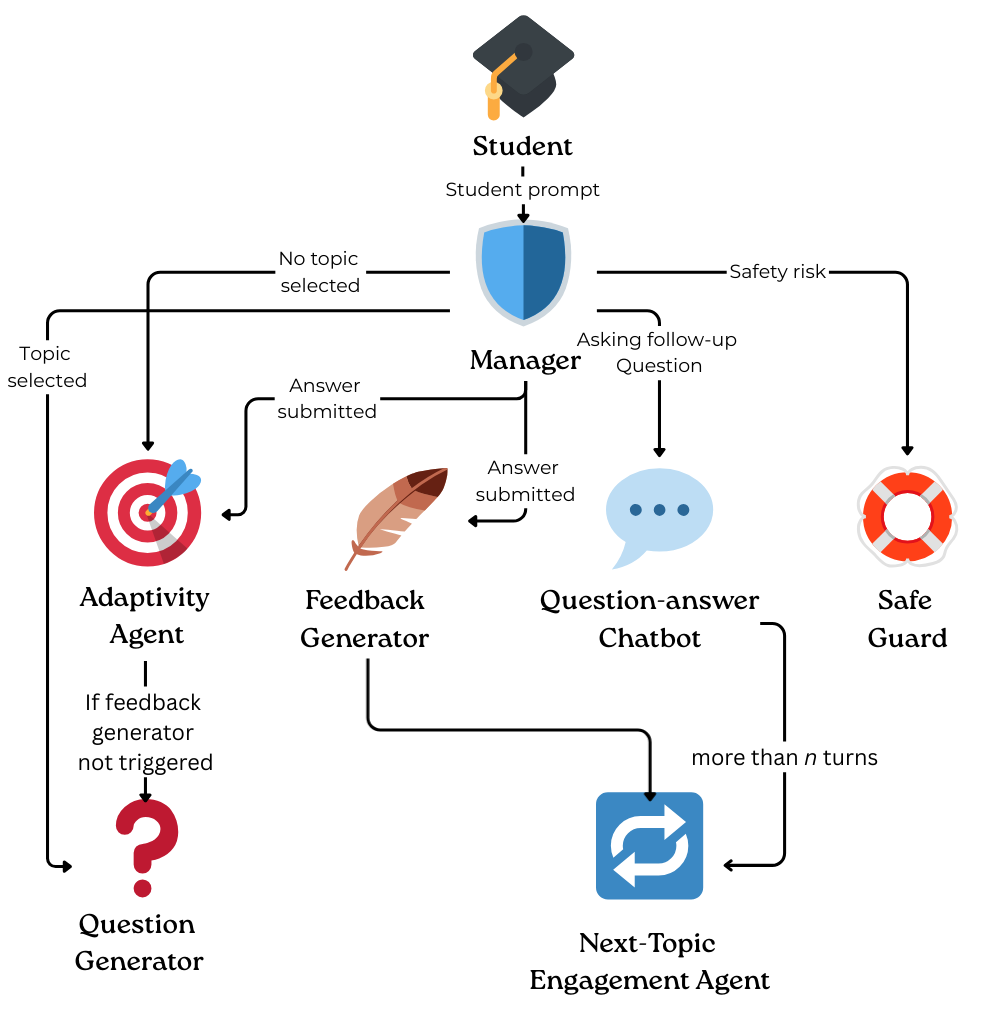
Many LLM-based knowledge tracing models have emerged rapidly, yet we still lack a coherent understanding of how large language models should be configured and evaluated within an intelligent tutoring system (ITS) that supports learner agency. AIFL addresses this gap as a GenAI-based ITS that provides after-class supplemental grammar and vocabulary practice through conversational interaction, using a multi-agent architecture in which an LLM-based adaptivity agent functions as a knowledge tracing module alongside six specialized agents.
Key Contributions
- MULTI-AGENT SYSTEM DESIGN — Proposed a multi-agent GenAI-based ITS informed by a user survey of French learners, with an LLM-based adaptivity agent operating alongside six agents each fulfilling a distinct instructional function to support adaptive personalization and meaningful student agency.
- QUANTITATIVE EVALUATION — Developed and evaluated the adaptivity agent using simulated students, benchmarked against Bayesian Knowledge Tracing (BKT) under controlled experimental conditions.
Key Findings
- MODEL STRENGTH MATTERS — Stronger language models (GPT-5-mini) match rule-based KT performance, offering a practical alternative that eliminates the need to maintain explicit learner-model code.
- AGENCY AND ADAPTIVITY COEXIST — Student agency does not reduce adaptivity. Learner control and adaptive personalization can coexist, with agency even reducing excessive topic repetition in some cases.
- PROMPT DETAIL MATTERS — LLM-based KT model performed better with more detailed student model descriptions in the prompt.
27th International Conference on AI in Education (AIED 2026). https://doi.org/10.1007/978-3-032-29760-0_35